CELLIVITY is available to adults only. Supplement pages are general product information; peptide records are not a sales offer and are not for human use.
Age confirmation is a declaration, not identity verification. Restricted research access still requires separate professional eligibility checks.Privacy and legal notice ↗
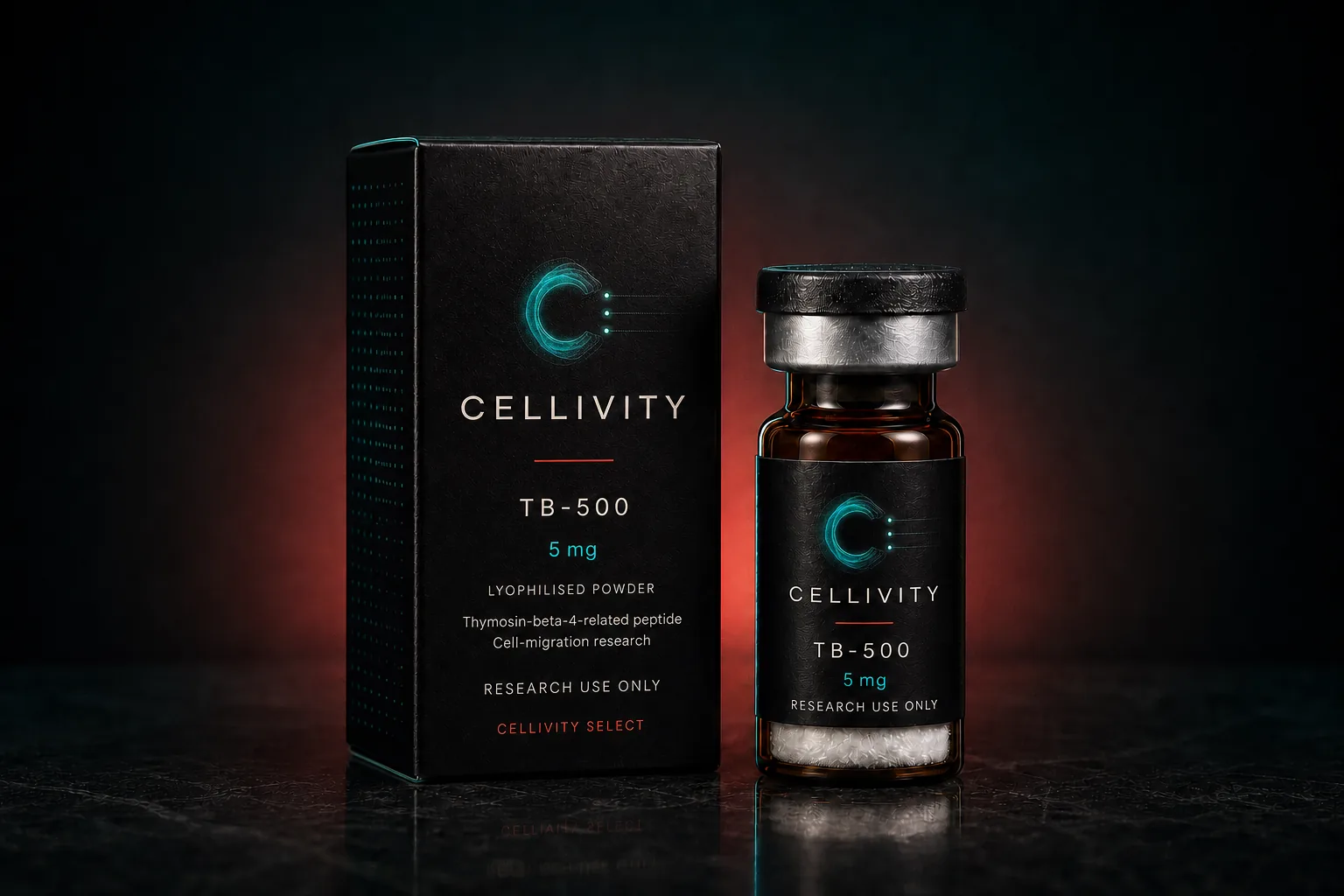
TB-500 is a market name used for thymosin-beta-4-related synthetic research material. Because the label can be used inconsistently, the exact sequence, molecular form and relationship to full-length thymosin beta-4 must be established before scientific comparisons are meaningful.
Research focus
Thymosin-beta-4-related cell-migration and tissue-response research.
Current evidence context
Mechanistic and preclinical observations do not establish a consumer recovery treatment. There is no well-established controlled human evidence for the commercial TB-500 category.
Questions this record follows
What exact molecule is being sold under the TB-500 name?
Which cell-migration and tissue-response effects reproduce independently?
What human pharmacology, immunogenicity and longer-term safety data are missing?
Follow the sources
Registry entries identify reference substances. Literature links describe research and do not certify this product or its batch.
Exact CELLIVITY-batch review is pending. Reference files below describe their own declared samples.
Reference clarification required
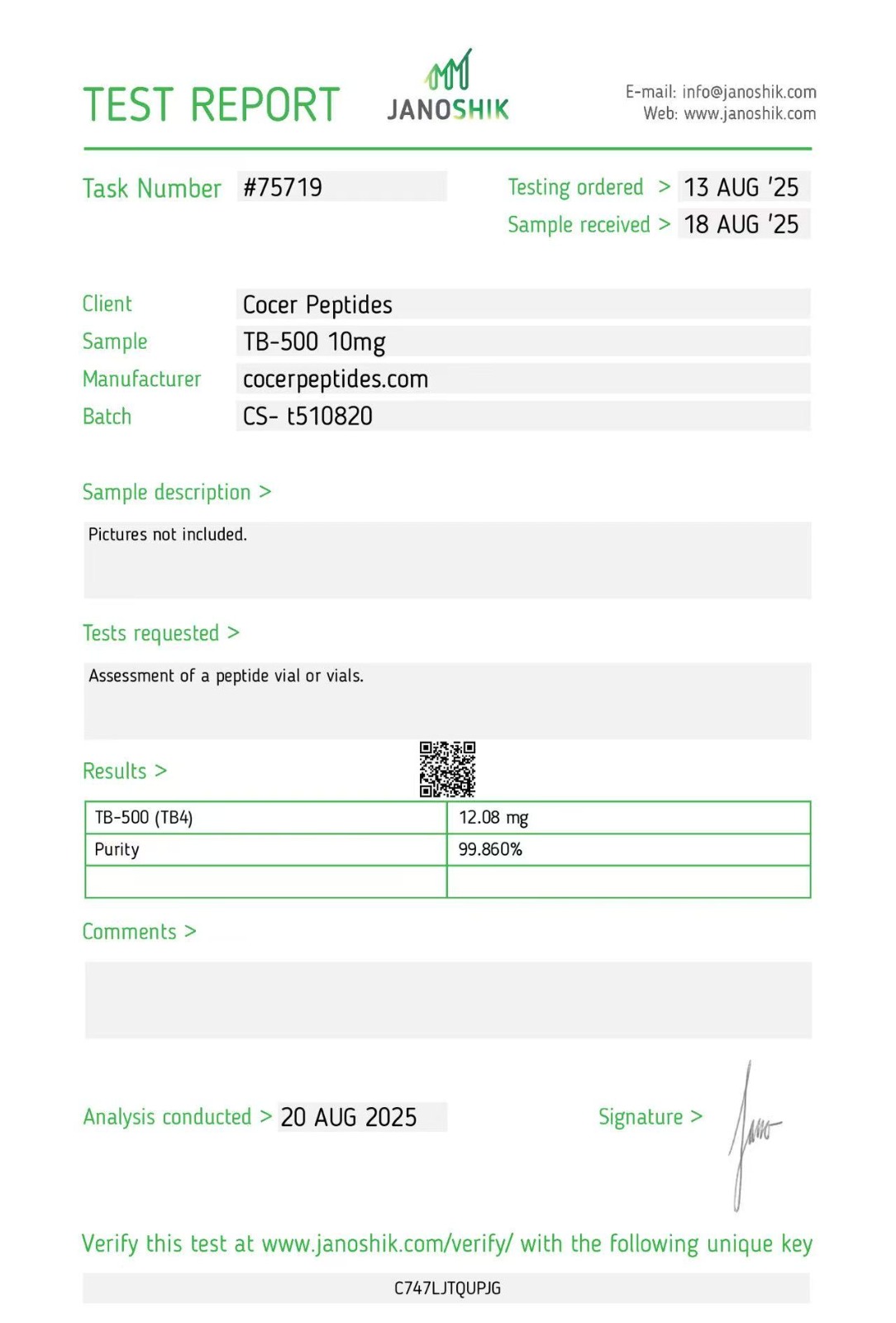
The report's TB-500 (TB4) label has not been matched to the seven-amino-acid fragment in the registry. Exact sequence and molecular mass need resolution.
Purity, identity, per-vial content and sterility are separate results.
Product
TB-500
Record
CEL-P-TB5-001
Files received
1
DOCUMENT RECEIVED · REVIEW PENDING
TB-500 10 mg analytical report
Report image shows 12.08 mg measured content and 99.860% purity.
Request current availability for a lawful institutional, analytical or laboratory purpose. We confirm the exact presentation, price, batch and document state before any next step.
Exact presentation review
Jurisdiction and purpose check
Batch-document confirmation
No medical or human-use guidance
SELECTED PRODUCTTB-500CEL-P-TB5-001 · response after manual review
TB-500: before you enquire
What exactly does the selected format mean?+
The mg or IU value is the declared material content per vial; it is not the container volume. Your selected presentation and quantity are saved with your enquiry. The final price is confirmed in the response.
Which batch will be supplied?+
The specific batch and its documents are confirmed in the response. Files shown here may be supplier reference samples; the current record does not yet contain a qualified CELLIVITY lot dossier.
When can it arrive in Thailand?+
For confirmed local stock, the planned window is 2–3 working days in Thailand. Pattaya timing is agreed directly. Incoming or specially sourced products have a separate estimate, confirmed before a commitment.
Can I enquire about several products together?+
Yes. Add each format and quantity to the cart, then send one availability enquiry. Your selected items are kept together for review.
CELLIVITY
TB-500
CEL-P-TB5-001 · 5 mg / 10 mg
TB-500 is a market name used for thymosin-beta-4-related synthetic research material. Because the label can be used inconsistently, the exact sequence, molecular form and relationship to full-length thymosin beta-4 must be established before scientific comparisons are meaningful.
Thymosin-beta-4-related cell-migration and tissue-response research.
Other names
TB-500 · Ac-LKKTETQ
PubChem CID
62707662
CAS number
885340-08-9
Molecular formula
C38H68N10O14
Molecular weight
889.0 g/mol
Peptide length
7 amino acids
Compound class
N-acetylated thymosin beta-4 fragment
Follow the sources
Mechanistic and preclinical observations do not establish a consumer recovery treatment. There is no well-established controlled human evidence for the commercial TB-500 category.
What exact molecule is being sold under the TB-500 name?
Which cell-migration and tissue-response effects reproduce independently?
What human pharmacology, immunogenicity and longer-term safety data are missing?